Otto · Giving homes memory, history and intelligence.
I founded, designed and built Otto, an AI-native home-ownership platform that turns inspection reports, documents, photos and maintenance information into a persistent home profile and prioritized plans.
I owned the product end to end, from research, product strategy, information architecture and interaction design through the design system, production frontend and backend, data model and AI inference, using modern coding tools and agents.
The Problem
Home information is scattered across reports, inboxes, photo libraries, and binders that are easy to lose and hard to trust. When something needs attention, homeowners have to reconstruct context from memory instead of from a single record. Inspectors, contractors, and insurers each keep their own version of the same house, and none of them stay in sync. The result is delayed decisions, duplicated work, and a home that never quite becomes knowable.

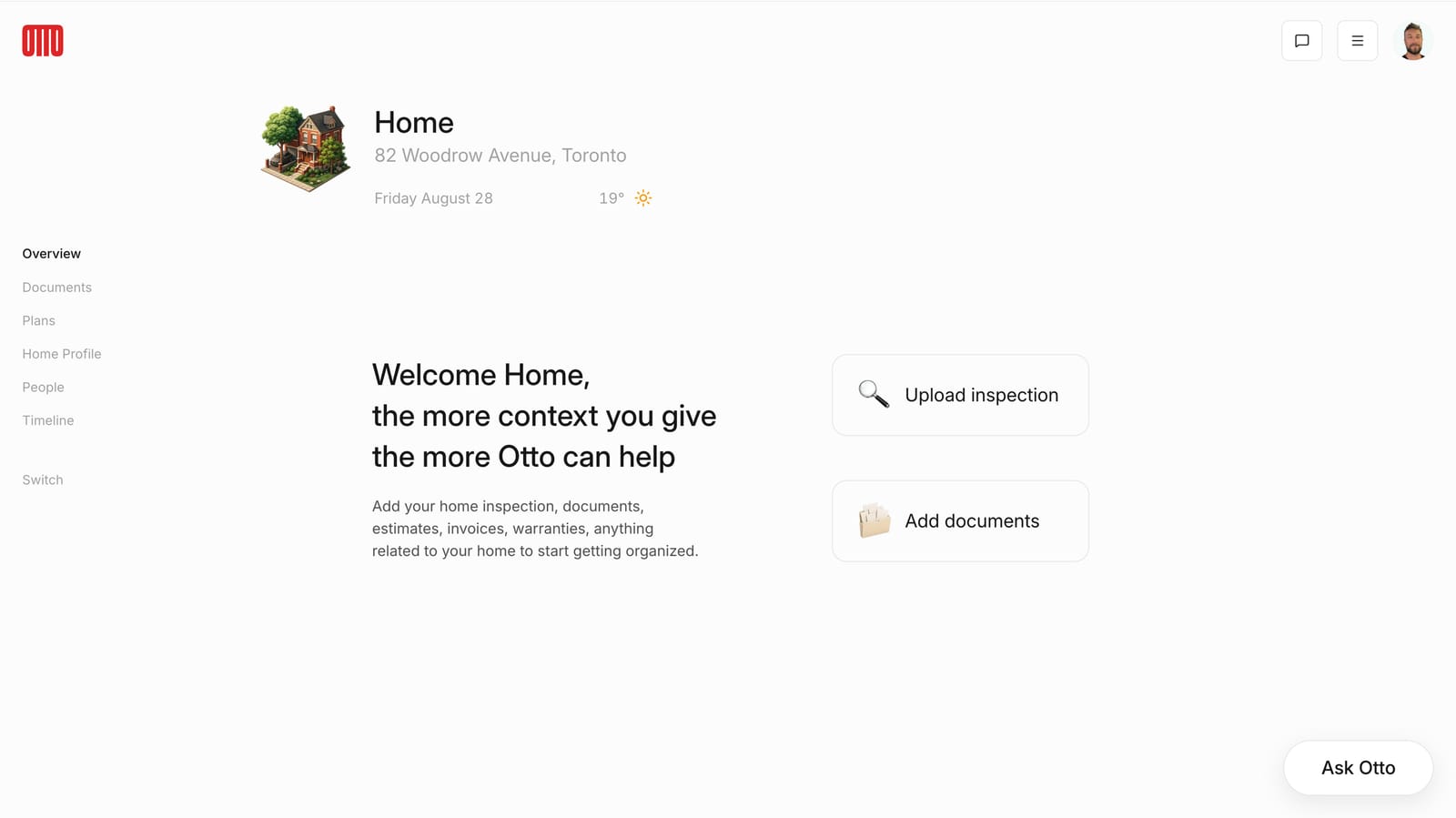
Our careers, health, finances, and even our cars have persistent digital records. Our homes do not. Information about a home remains scattered across inspection reports, invoices, warranties, photographs, email threads, and individual memory. I founded Otto to give every home a living digital profile: a structured record of what it is, what has happened to it, and what should happen next.
Research
I performed over two dozen user interviews with homeowners, friends, family members and past clients. The audio was aggregated in notebook lm and the patterns were striking. The majority of the homeowners I spoke to felt as though their home and it's management was a significant source stress and anxiety in their lives. Many said that despite it being so valuable, but monetarily and emotionally, their homes information was completely disorganized and resided in paper form, in emails, text messages, random spreadsheets and in their memories.
The Most Common Concerns of Owning a Home
- The Anxiety of Unseen and Aging Systems
- Total Operational Unpreparedness
- Reactive "Whack-a-Mole" Financials
- Relational Friction in Co-Ownership
“Nobody has taught you anything about how to maintain property... you lack all the things you need to understand to not get swindled and to not feel stupid. And you can't know them all.”
“We're already kind of playing chicken with the roof. Like that is, when I think about it, causes me immense stress.”
“This house is the most stressful part of our life.”
The Otto Product Promise
The Home Intelligence Loop
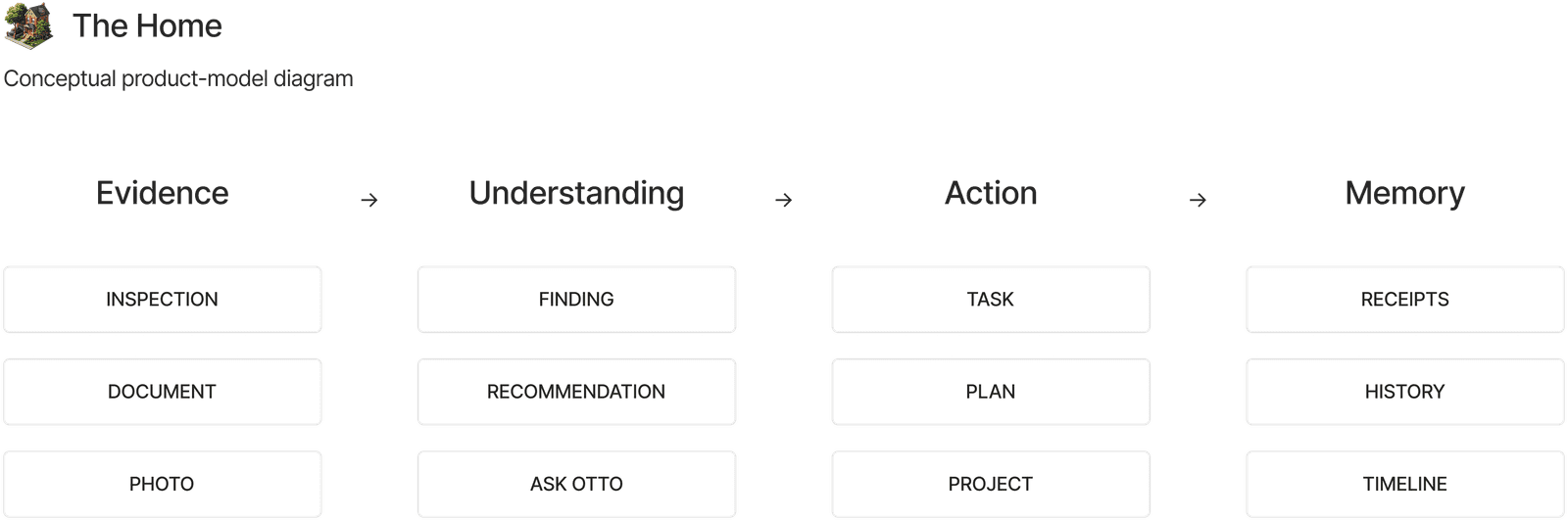
Otto turns home information into structured, understanding, action and persistent history.
An inspection produces a finding, recommendation, task, plan, completed work, and home history. The loop then appears as document, Ask Otto, recommendation, task, plan, completed work, and home history.


The shipped loop
Create an Otto account
Access to Otto starts with an invite code. Invitees enter the code from the landing page, then create an account with Oauth, or email magic link.
Create new property
A new account starts empty: add a property, search its address, and give it a nickname. You then choose a type, skip or enter purchase details, and confirm the record before Otto creates the home.
Upload your home inspection
Once a property is created, users are encouraged to upload a home inspection or home documents. Otto parses a home inspection and uses the findings to populate the home profile’s nine systems. It also prioritizes the home inspection findings by severity, and orders them relative to when each finding should be attended to.
Otto fills out your home profile
After parsing, Otto fills the home profile with nine systems and their open findings. Opening a system shows each finding in context, then the prioritized tasks that should follow.
Create a plan
Placeholder.
Complete a task
Placeholder.
Preserve the record
Otto will save the completed task and add it to your homes timeline.
Ask Otto
- Placeholder.
- How homeowners ask questions about the home.
- What Otto can see in the record.
- How answers stay grounded in evidence.
Placeholder.
Homes are multiplayer
Making the home’s implicit social graph explicit
A home may have one address, but it is rarely a single-user object.
Partners make decisions together. Family members share responsibilities. Tenants report problems. Realtors assemble closing documents. Inspectors identify deficiencies. Contractors contribute estimates, photos, invoices, and maintenance history. Over the life of a home, many people participate in understanding, maintaining, and improving it.
Those relationships already exist, but they are usually implicit. The context surrounding a home is scattered across email threads, text messages, cloud folders, paper records, and individual memory. One person may know when the roof was replaced, another may have the warranty, and a contractor may be the only person who understands what was repaired.
I began to think of this as the home’s implicit social graph: a network of people connected not because they follow one another, but because they share some relationship to the same property.
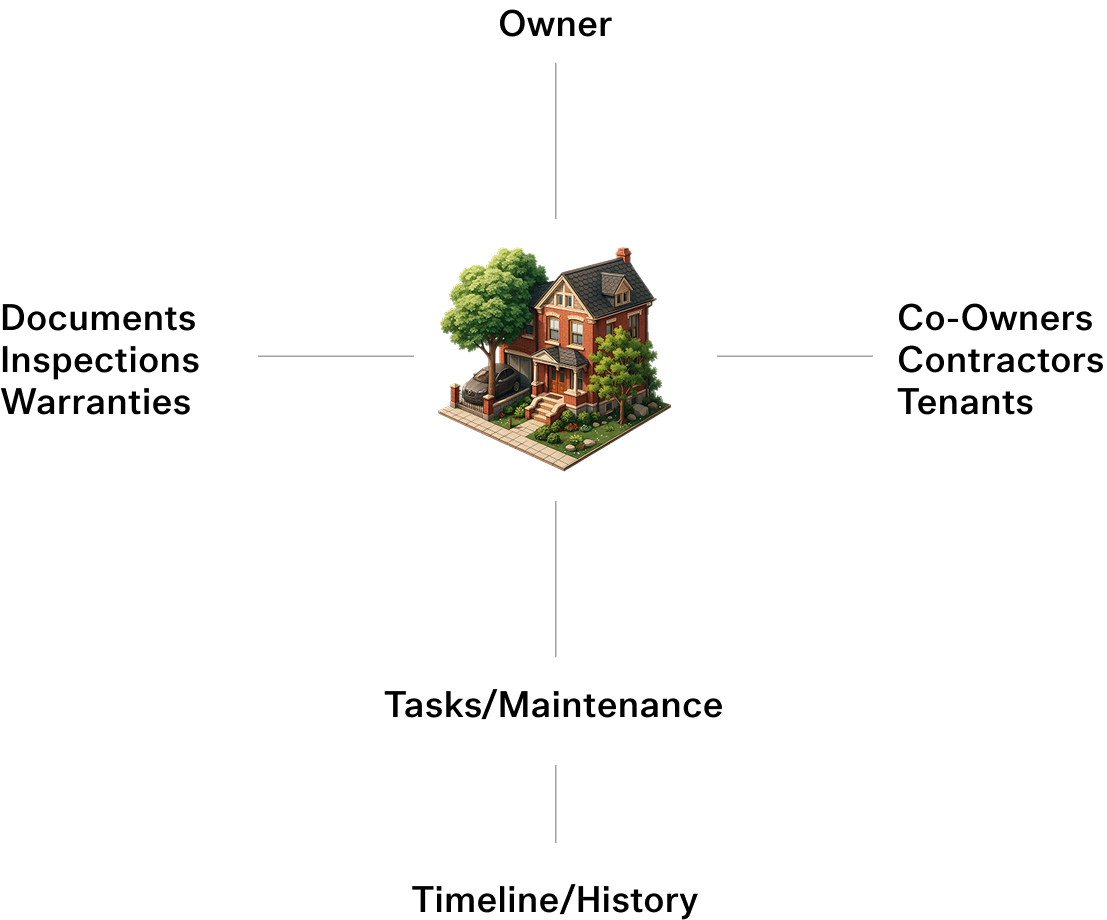
Otto makes that graph explicit by placing the home, not the individual user, at the centre of the product.
People join a home through defined relationships and roles. Documents, findings, tasks, plans, conversations, and completed work remain connected to the property, while permissions determine who can view, contribute to, or manage each part of the record.
This led to several foundational product decisions:
1. Property-centred architecture
Information belongs to the home rather than being trapped inside one person’s account.

Domain canonicity
The product’s main objects exist independently and users participate in them.

Identity canonicity
Most objects are understood through their relationship to a user
Typical identity-centric social product
identity-centric
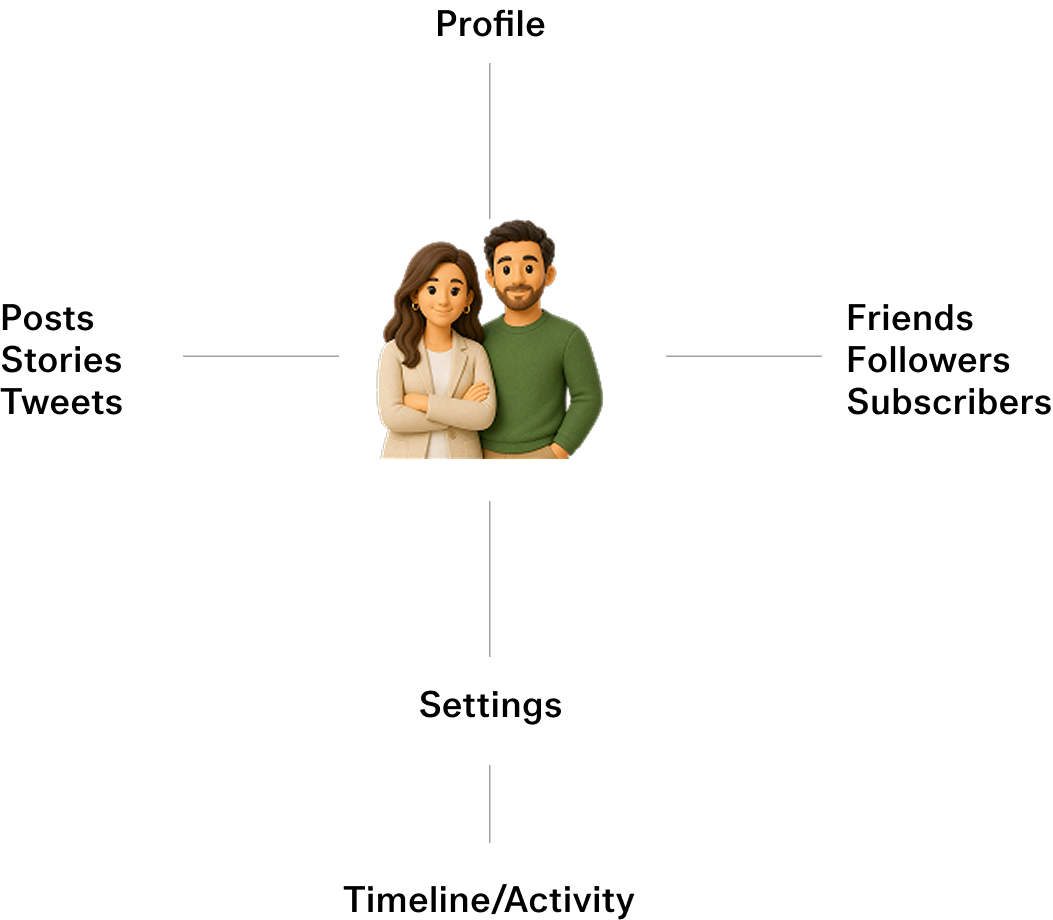
Most homeowner software treats the home as data inside an account.
Otto treats the home as the durable object and people as participants in its history. This makes the property transferable: ownership, access, and roles can change over time without fragmenting or resetting the home’s underlying record.
The broader idea is that a home deserves a persistent profile of its own, one that accumulates documents, maintenance, improvements, warranties, and institutional memory across its entire life.
Otto
property-centric
2. Membership and roles
A person’s relationship to a property is represented explicitly, allowing for owners, co-owners, family members, tenants, realtors, inspectors, contractors, and other participants.
3. Shared responsibility
Tasks and plans can have owners, contributors, and a visible history of who did what.
4. Scoped access
Not every participant should see or change everything. Access can reflect the person’s role and the work they are involved in.
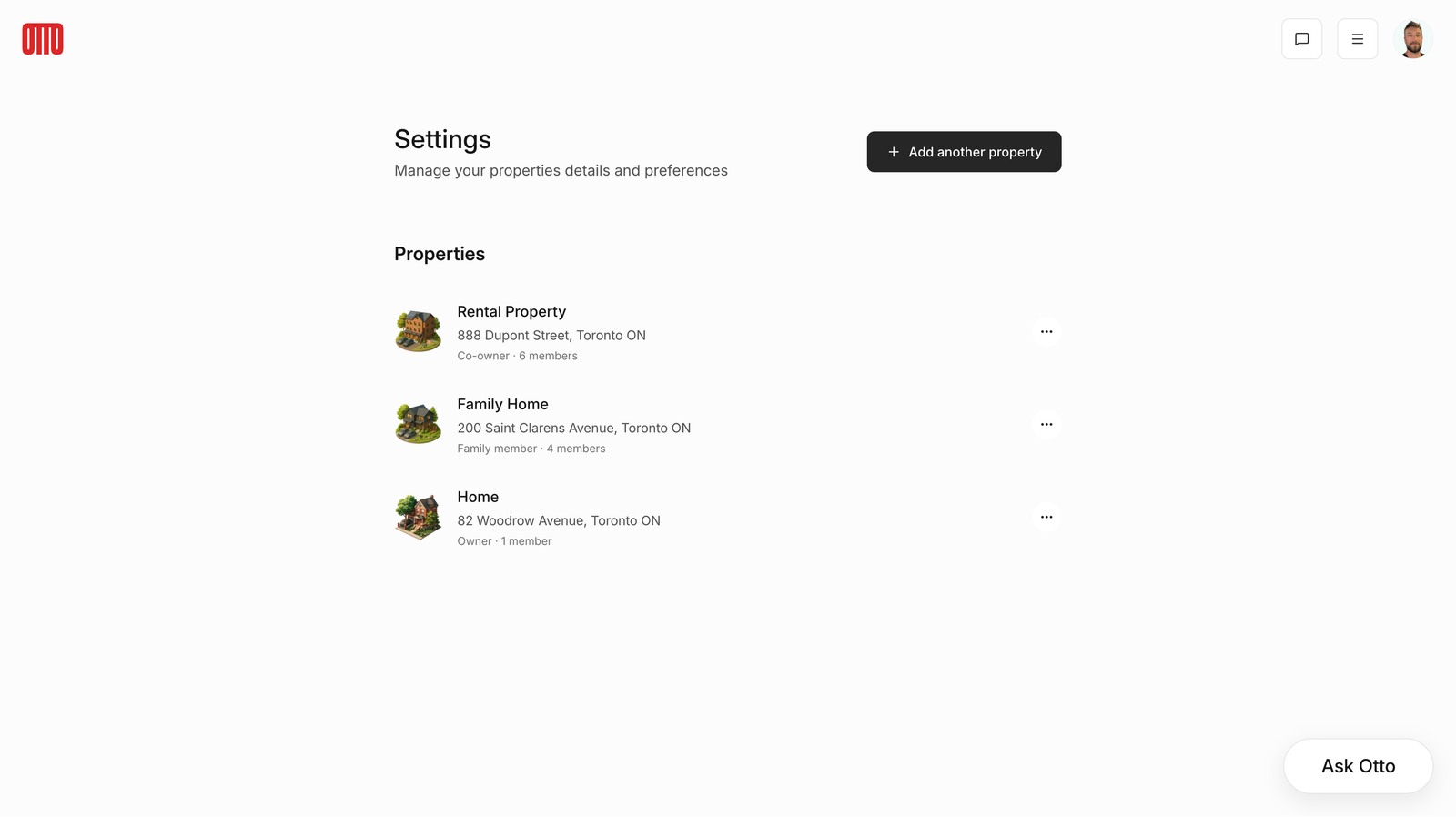
5. Multi-property support
The same person may participate in several homes—and may have a different role in each one.
6. Persistent history
When a contractor finishes a repair, a family member moves out, or a property changes hands, the underlying record remains attached to the home.
The first version of Otto prioritizes owners and co-owners, but I designed the underlying model to support the broader network that naturally forms around a property.
This changed Otto from a personal home-maintenance dashboard into something more durable: a shared system of record through which the people responsible for a home can coordinate decisions, contribute knowledge, and preserve its history over time.
The Production Stack
- LinearProject management
- Next.jsReact web framework
- Shadcn UIComponent library
- SupabaseDatabase
- VercelWeb hosting
- Codex & CursorCoding agents
- ResendEmail API platform
- TurbopufferServerless vector search